

TL;DR: Best Customer Review Sites for Your Business
Google Reviews: free, and shown in Search and Maps. Start here if you serve local customers.
Trustpilot: open review platform with invitation tools. Good for online stores.
Yelp: free business page. Strong for restaurants and home services.
Tripadvisor: the main review site for hotels, restaurants and attractions.
G2: where B2B software buyers compare products.
Shapo: not a review site, but a way to collect testimonials and show your reviews on your own website.
What to do:
Pick 2 or 3 platforms your customers already use.
Ask for reviews right after a good experience, and reply to every review.
Put your best reviews on your own site, where buyers make the decision.
The best customer review site for most businesses is Google, because reviews there appear in Search and Maps at no cost. Add one site built for your industry: Trustpilot for online stores, Yelp for local services, Tripadvisor for travel and G2 for B2B software.
Below you will find those five sites plus Shapo, which helps you collect reviews and show them on your own website. Every figure below comes from the platform's own site, checked on September 23, 2026.
- Google Reviews: the first place local customers see reviews, in Search and Maps.
- Trustpilot: free plan with 50 review invitations a month, paid plans for more.
- Yelp: free business page for restaurants, shops and home services.
- TripAdvisor: the review site travellers check for hotels, restaurants and things to do.
- G2: peer reviews and comparisons for B2B software.
- Shapo: collect text and video testimonials and show them, with imported reviews, in widgets on your site.
Quick Comparison
| Platform | Best For | Key Features | Limitations |
|---|---|---|---|
| Google Reviews | Local businesses | Free Business Profile, reviews in Search and Maps, owner replies | No incentives allowed for reviews |
| Trustpilot | Online stores | Review invitations, TrustScore widgets, integrations | Free plan capped at 50 invitations a month; paid from $99/mo billed yearly |
| Yelp | Restaurants and local services | Free business page, photos, replies to reviews and messages | Ads and upgrades cost extra |
| TripAdvisor | Travel and hospitality | 1B reviews and opinions, 8M+ locations | Little use outside travel, dining and attractions |
| G2 | B2B software | Free vendor profile, G2 Grid, comparisons | Only relevant to software and business services |
| Shapo | Showing reviews on your own site | Text and video testimonials, imports from 30+ platforms on Pro | Not a public review site; free plan holds 15 testimonials |
In short: choose platforms by where your customers look, then manage those few well.
Which Online Reviews Will Help YOUR Business Most?
Pick review sites the way your customers search, not by which platform is biggest. Four questions settle it for most businesses.
- Where do buyers look before they choose you? Local customers use Google Search and Maps, software buyers compare on G2, and travellers read Tripadvisor.
- What shows up when someone searches your name? Claim and complete that profile first, because it is already shaping first impressions.
- Can you keep up? Two or three platforms you reply on and ask for reviews on beat six you ignore.
- How will the reviews work on your own site? Reviews persuade most on your pricing and product pages. A review widget or a Wall of Love page brings them there.
1. Google Reviews
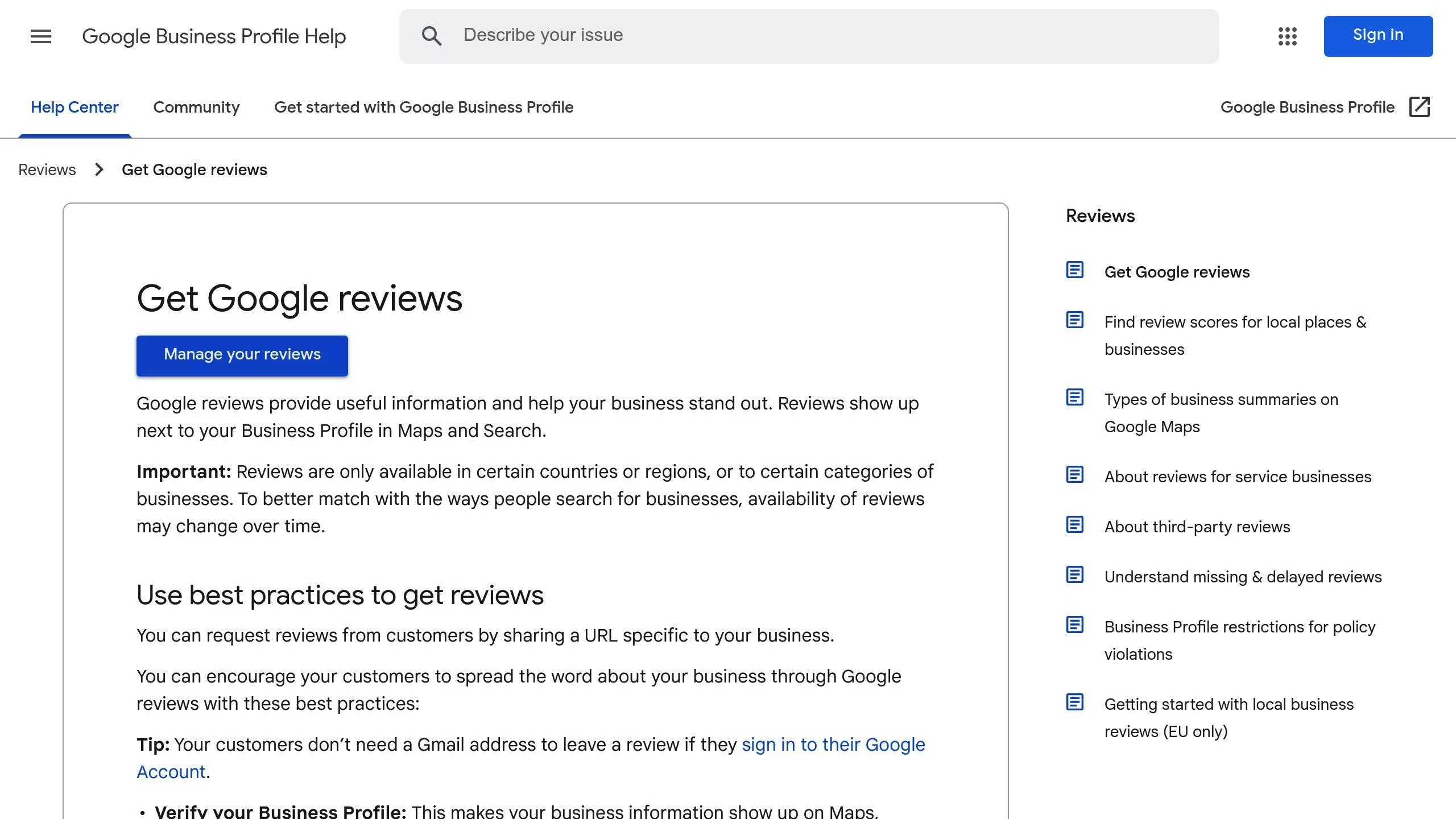
Google reviews appear on your Business Profile in Google Search and Maps, so they are often the first reviews a local customer sees. Creating a Business Profile and listing your business on Google is free, and you can respond to customer reviews from it (Google Business Profile).
Reviews combine a star rating with written customer feedback. Customers must be signed in to a Google account to leave one. Google's rules also ban offering incentives, such as free or discounted goods, in exchange for reviews (Google review policy).
To get the most out of Google Reviews:
- Ask for reviews right after completing a service.
- Respond to all reviews within 24-48 hours.
- Use what customers tell you to fix real problems.
- Monitor reviews consistently to maintain search visibility.
Track these numbers to see whether your effort is paying off:
| Metric | Business Impact |
|---|---|
| Review Quantity | Improves local search visibility |
| Response Rate | Builds trust with customers |
| Star Rating | Encourages more clicks in search results |
| Review Frequency | Shows active engagement |
For businesses with local customers, Google is the review site to get right first. A steady flow of genuine reviews, with a reply to each, does more than a burst of reviews followed by silence.
Your Google reviews can also work on your own website. A Google review widget shows them on your homepage or pricing page, and a Review Booster page gives happy customers one link to leave a review.
Online stores selling to customers in many regions may find Trustpilot a better fit as a second platform.
2. Trustpilot
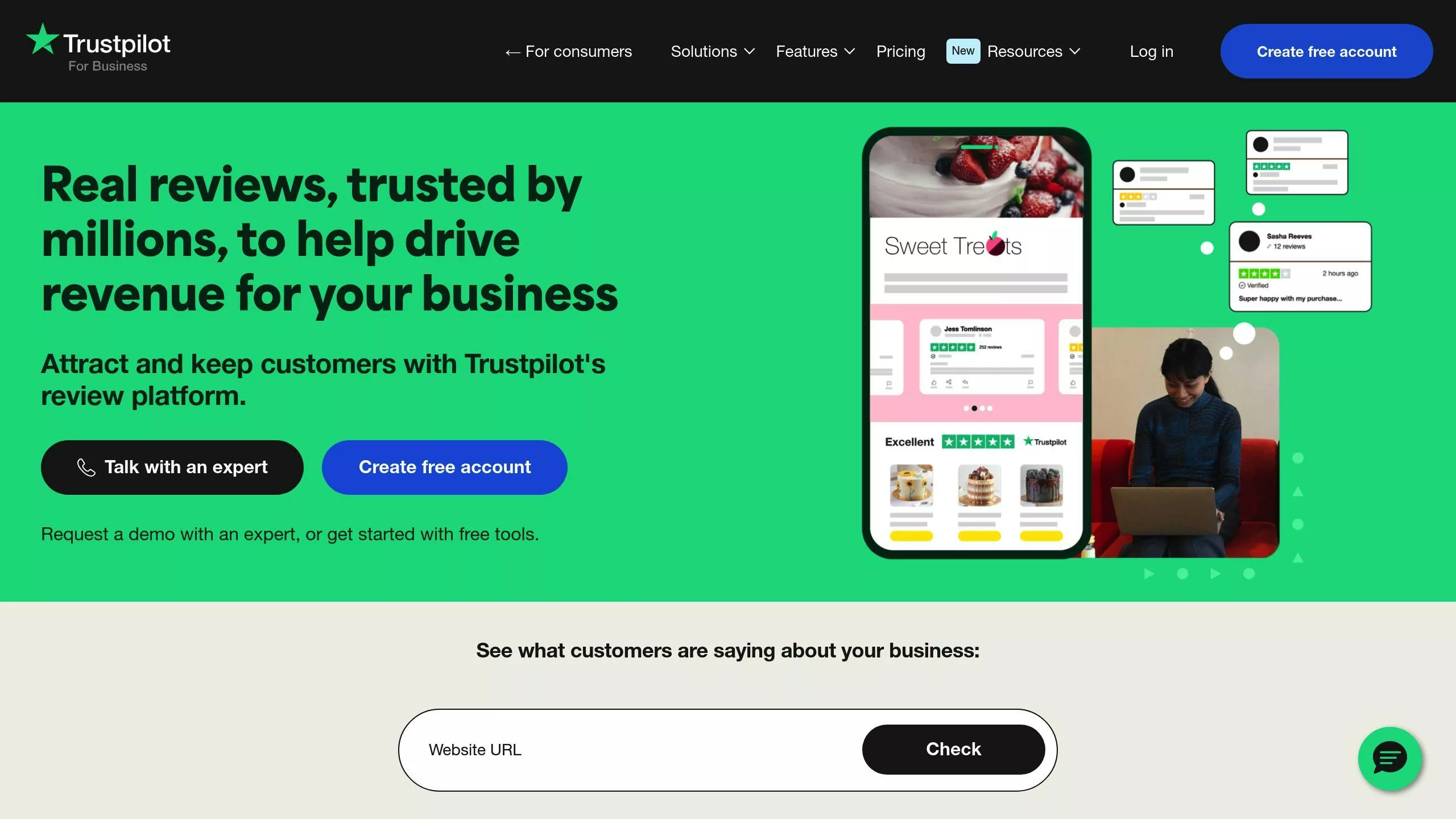
Trustpilot is an open review platform used widely by online stores and service companies that sell across borders. Businesses invite customers to leave a review, reply to what they write, and show their TrustScore and reviews on their own site with widgets.
What each plan gives you, from Trustpilot's plans page:
| Feature | Business Benefit | How It Works |
|---|---|---|
| Review invitations | More reviews from real customers | 50 a month on Free, 100 on Starter, 300 on Plus, 1,000 on Premium |
| Widgets | Show your TrustScore and reviews on your site | 2 review collection tools on Starter, 10 widgets on Plus, 21 on Premium |
| Integrations | Send invitations from your store and marketing tools | 15 integrations on Starter, all integrations from Plus |
The free plan includes a basic profile page, 50 review invitations a month and replies to reviews. Starter costs $99 a month billed annually, Plus $319 a month per domain billed annually, and Premium $799 a month per domain billed annually (Trustpilot plans).
Reply to reviews, including the critical ones, because future customers read the replies too. For local or service-based companies, Yelp is often the better second platform.
3. Yelp
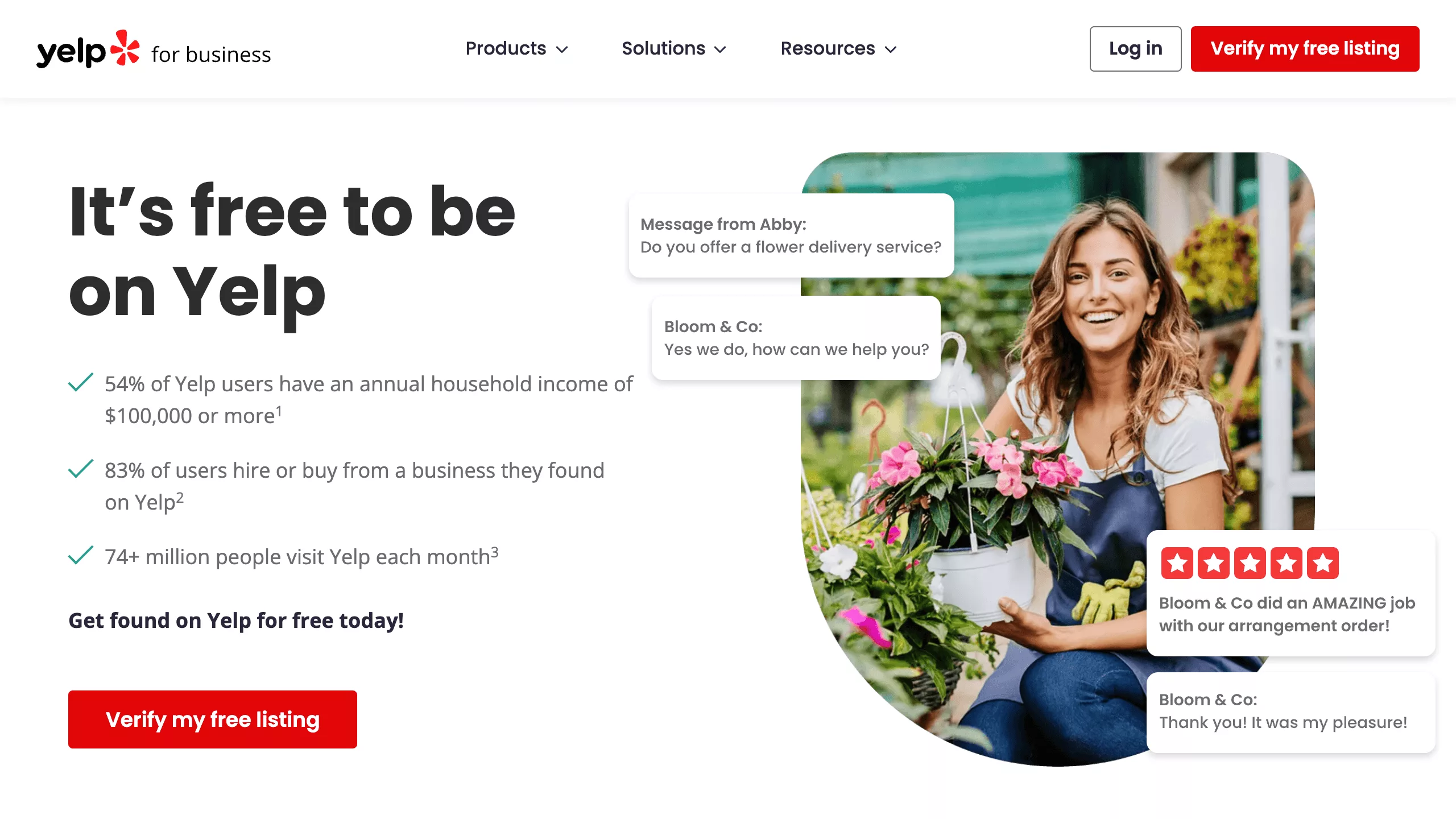
Yelp is a review site for local businesses, especially restaurants, shops and home services. Yelp says 74+ million people visit each month and that 82% of users hire or buy from a business they found there (Yelp for Business). Its investor site reports 330 million cumulative reviews (Yelp investor relations).
What businesses get on Yelp:
| Feature | Benefit for Businesses |
|---|---|
| Free business page | Keep your details correct so people can find you |
| Replies | Respond to reviews and messages as they come in |
| Photos | Show the best of your business |
| Yelp Ads (paid) | Target customers by location and keyword, and appear on competitors' pages |
To make the most of Yelp, businesses should:
- Claim and verify their business listing
- Regularly update photos, hours, and service details
- Respond to reviews promptly to maintain a strong local reputation
It is free to be on Yelp. Yelp Ads and an Upgrade Package are the paid options for businesses that want more visibility.
For hotels, restaurants that serve tourists and attractions, Tripadvisor is usually the better fit.
4. TripAdvisor
Tripadvisor is the main review site for travel and hospitality. It reports 490 million monthly unique visits, 1 billion reviews and opinions, and 8 million+ locations, including hotels, restaurants and attractions (Tripadvisor for Business). If you run a hotel, a restaurant in a tourist area or a tour business, travellers will look for you here.
Tailored Features for Different Businesses
Hotels, restaurants, attractions and tour operators can all claim a listing and reply to reviews. Restaurants get heavy traffic: Tripadvisor says 2.5 million people visit restaurant pages every day.
Premium Tools for Hospitality Businesses
Business Advantage is Tripadvisor's paid listing upgrade, aimed mainly at hotels that want more direct bookings (Business Advantage). It includes:
| Feature | How It Helps |
|---|---|
| Featured review | Pin the review that best shows what guests love |
| Photo and video carousel | Show the property in an interactive gallery |
| Direct booking tools | Tap-to-call and contact details on mobile |
| Special offers | Guests click to redeem offers on your own website |
| Competitive analytics | Traffic trends, ranking data and competitor benchmarks |
How to Maximise Your Presence
To make the most of Tripadvisor:
- Keep listings detailed and up-to-date.
- Upload sharp, recent photos of your rooms, dishes or experiences.
- Monitor competitors to stay ahead in your market.
Safeguarding Your Reputation
Check your listing regularly and report reviews that break Tripadvisor's guidelines. Reply calmly to negative reviews, because future guests read your replies as closely as the reviews.
Tripadvisor matters little outside travel, dining and attractions. Software and tech companies should look at G2 instead.
5. G2
G2 is where B2B software buyers read peer reviews and compare products. It says it serves more than 200 million annual buyers and lists 200,000+ products and services (About G2), and it cites 3M+ reviews on its vendor site (G2 for vendors).
Buyers use G2's category grids and side-by-side comparisons to build a shortlist. For a SaaS company, a strong G2 profile works like a reference call that happens before you know the prospect exists. Reviewers often describe the ROI they got, which is the detail other buyers look for.
Vendors can claim a free profile. Paid products include review programmes that also count toward the G2 Grid, buyer intent data, market intelligence and a content marketing subscription.
G2 only matters if you sell software or business services. Whatever your industry, you can also bring reviews from G2 and other sites onto your own pages as testimonial widgets.
6. Shapo
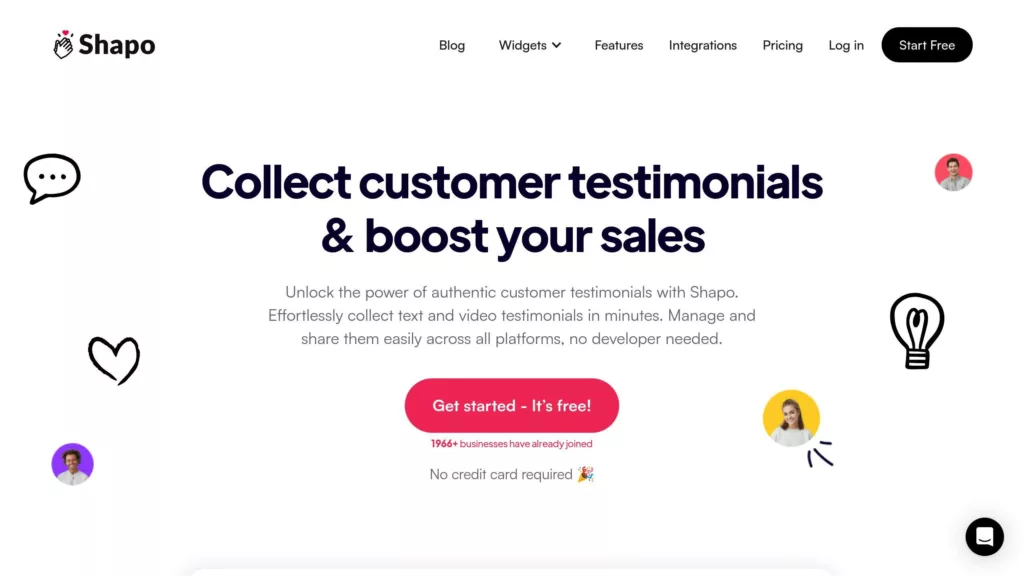
Shapo is not a public review site like the five above. It is a testimonial platform that collects testimonials from your customers and shows them, together with reviews from other sites, on your own website. That is where a prospect decides, so it is where reviews earn the most.
What it does:
Review Collection and Management
- Collection forms for text and video testimonials, a star rating and photos.
- Email campaigns on Pro, with up to 500 invites a month.
- Imports on Pro from 30+ platforms, including Google, Facebook, Capterra, G2 and Trustpilot.
Display and Integration
- Carousel, grid, marquee, list, badge and floating toast widgets, plus a hosted Wall of Love page.
- One embed snippet that works on any site, including Shopify, WordPress and Webflow.
- A Review Booster page to send happy customers to when you ask for reviews.
| Plan | Features |
|---|---|
| Free | $0 with no time limit: up to 15 testimonials, unlimited widgets and forms, video and image testimonials, a Wall of Love page and a Review Booster page |
| Pro | $29 a month or $290 a year: unlimited testimonials, imports from 30+ platforms, 500 email invites a month, branding removed, custom domain for the Wall of Love and Review Booster |
Use Shapo alongside the review sites above, not instead of them. Keep collecting on Google or your industry site, then bring the best reviews to your pricing and product pages. For layout ideas, see these Wall of Love examples.
Platform Strengths and Limitations
The table below sums up the strengths and limits of each review platform:
| Platform | Key Strengths | Notable Limitations |
|---|---|---|
| Google Reviews | Free Business Profile Reviews shown in Search and Maps Owners can reply to every review | Incentives for reviews are banned Reviewers need a Google account |
| Trustpilot | Review invitations on every plan TrustScore widgets for your site Integrations with store and marketing tools | Free plan limited to 50 invitations a month Paid plans from $99 a month, billed yearly |
| Yelp | Free business page 74+ million monthly visitors, per Yelp Strong for restaurants and home services | Extra visibility means paying for Yelp Ads Less relevant for online-only businesses |
| TripAdvisor | 1 billion reviews and opinions 8 million+ travel and dining locations Business Advantage tools for hotels | Little use outside travel, dining and attractions |
| G2 | Free vendor profile Category grids and comparisons Buyers already shortlisting software | Only relevant to software and business services Main vendor programmes are paid |
| Shapo | Text and video testimonials Imports from 30+ platforms on Pro Widgets and a Wall of Love for your own site | Not a public review site Free plan holds up to 15 testimonials |
The right mix depends on your business. Local restaurants usually lean on Google for search and Yelp for local discovery. B2B software companies tend to rely on G2 for credibility with buyers, and online stores often add Trustpilot.
Choose the platforms that match your industry, audience and the time you have. Budget matters less than it seems, since every site above offers a free profile or plan, but replying to reviews takes steady effort.
Which review sites to focus on
Different review platforms serve different businesses. Here is how to use them.
Google Reviews comes first for almost any business with local customers. It is free, and reviews appear in Search and Maps where people are already looking for you.
Trustpilot suits online stores and companies selling across borders. Its free plan covers 50 review invitations a month, which is enough to test it before paying.
Choosing the Right Review Site
Pick the platform your buyers already trust for your kind of business.
Matching Platforms to Your Industry
- Travel and hospitality: Tripadvisor, with 1 billion reviews and opinions across 8 million+ locations.
- B2B software: G2, which says it serves more than 200 million annual buyers.
- Restaurants and local services: Yelp, alongside Google.
- Online stores: Trustpilot, alongside product reviews on your own store.
Tips for Managing Reviews Effectively
A few habits matter more than the platform you choose:
- Stay active on the 2 or 3 platforms your audience uses most.
- Reply to every review, positive or negative, within a day or two.
- Ask for reviews right after a good experience, with one direct link.
- Show your best reviews on your own site with a Google review widget or testimonial widgets.
You do not need to be everywhere. Do well on the few platforms your customers use, then put those reviews in front of buyers on your own pages.
FAQs
What is the best site for customer reviews?
It depends on your business, but for most companies with local customers the answer is Google Reviews. A Business Profile is free, and reviews appear in Google Search and Maps.
After Google, pick one site built for your industry: Trustpilot for online stores, Yelp for restaurants and home services, Tripadvisor for hospitality and G2 for B2B software.
Which is the best review platform?
The best platform is the one your buyers already check. Google Reviews leads for local search. Trustpilot suits online stores, and G2 is where software buyers compare products. To use those reviews on your own website, a testimonial tool such as Shapo can collect new testimonials and, on Pro, import reviews from 30+ platforms.
Focus on 2 or 3 platforms that fit your business and audience, and manage them well, rather than spreading thin across every review site.