
Responding to positive reviews can boost your business. Here’s why it matters and how to do it effectively:
Quick Summary: Key Takeaways
- Speed Matters: Aim to respond to positive reviews within 24–48 hours to show attentiveness.
- Personalization is Key: Mentioning specific products or staff names can increase customer retention by up to 80%.
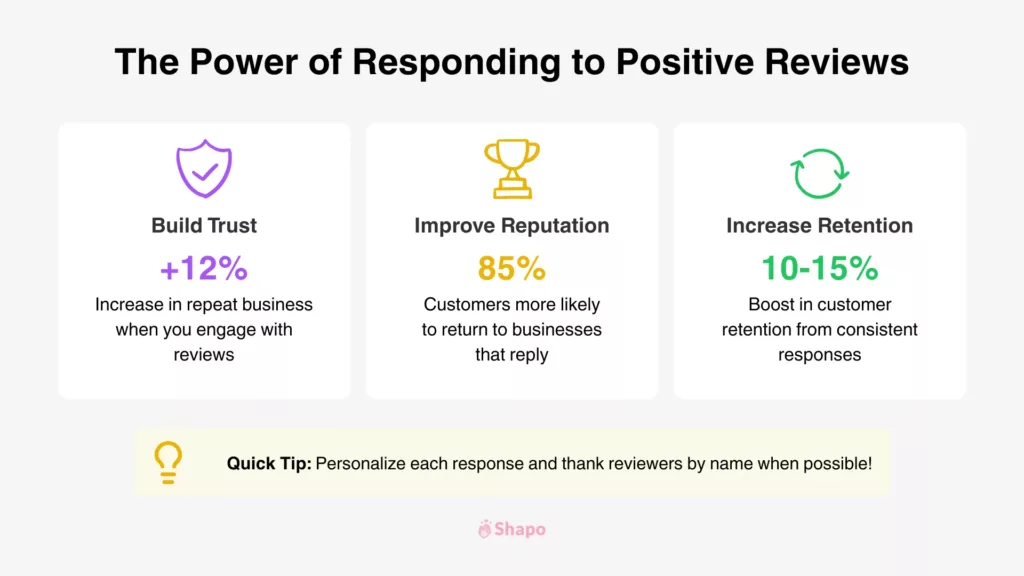
- Business Growth: Consistent engagement with reviews can boost repeat business by 12% and retention by 10-15%.
- SEO & Conversion: Displaying reviews on your homepage can increase conversion rates by 270% and improve local search visibility.
QuQuick Tips:
- Be Prompt: Reply within 24-48 hours to show attentiveness.
- Personalize: Reference specific details from the review.
- Stay Professional: Use a warm, professional tone.
- Add Gratitude: Thank customers sincerely.
- Encourage Future Visits: Highlight upcoming opportunities to serve them again.
Example:
“Thank you, [Name]! We’re thrilled you enjoyed our [specific product/service]. Your feedback means a lot, and we look forward to seeing you again soon!”
Positive review responses aren’t just about saying thanks – they’re a tool for trust, retention, and growth.
Benefits of responding to positive reviews
Responding to positive reviews builds customer trust, strengthens your online reputation, and increases retention rates by 10-15%. These three benefits directly impact revenue and repeat business.
Building trust
Responding to reviews shows customers you care about their experiences. According to Harvard Business Review, businesses that engage with customer feedback see a 12% boost in repeat business. This public interaction strengthens existing relationships and builds trust with potential customers.
Managing reputation
Responding to reviews plays a big role in shaping your online reputation. A BrightLocal study found that 85% of customers are more likely to return to businesses that reply to their reviews.
Consistent review responses also:
- Encourage more feedback: Customers feel heard and are more likely to leave reviews
- Improve local SEO: Active review management signals relevance to search algorithms
- Signal reliability: Prospects see active management as a sign of quality
Retaining customers
One of the biggest advantages of responding to reviews is the impact on customer loyalty. Gartner‘s analysis shows that businesses with consistent review response practices see a 10-15% increase in customer retention rates. Acknowledging positive feedback makes customers feel valued and reinforces their loyalty.
Review response examples by situation
Tailor your response based on the review type—whether it’s a 5-star rating, a staff mention, or feedback from a first-time customer. Businesses that actively reply to positive reviews see a 12% boost in overall review volume.
4-star and 5-star review responses
| Rating Context | Response Example |
|---|---|
| 5-Star (Detailed Praise) | “Thank you! We’re thrilled that our [specific service/product] exceeded your expectations.” |
| 4-Star (General Positive) | “We appreciate your 4-star review. We’d love to hear any suggestions for making your next experience even better.” |
Staff and product mention responses
Studies show that personalized responses referencing specific details can improve customer retention by up to 80%.
“Thank you for recognizing Sarah’s excellent service! She was excited to hear your feedback. Our team is dedicated to providing great care, and your kind words mean so much to us.”
For product mentions: “Thank you for highlighting our Premium Coffee Blend and our team’s efforts. Feedback like yours motivates us to keep delivering outstanding results.”
New customer review responses
“Welcome to [Business Name]! We’re so glad you enjoyed your first visit with us. As a token of appreciation, enjoy 15% off your next visit – just mention this response!”
Business-specific responses
Different industries require unique responses tailored to their services:
Restaurant: “Thank you for trying our seasonal menu! Chef Michael is delighted you enjoyed the truffle risotto. We look forward to sharing more seasonal dishes with you soon.”
Hotel: “We’re thrilled you loved our oceanfront suite and sunrise views. We’ve noted your room preference for your next stay!”
Retail: “We’re so happy our team helped you find the perfect [product]. Your satisfaction is what drives us!”
Writing strong review responses
A strong review response includes three elements: gratitude, specificity, and a forward-looking statement. Businesses that respond to reviews see an 80% boost in conversion rates compared to those that don’t.
Key elements of a response
A strong response to a positive review should include these four elements:
| Element | Example |
|---|---|
| Gratitude | “Thank you for sharing your experience with us!” |
| Specificity | “We’re thrilled our quick delivery met your needs.” |
| Future Focus | “We look forward to serving you again soon.” |
| Call to Action | “If you’re ready, we’d love to help again—book your next visit anytime.” |
Adding a personal touch
Personalizing your responses goes beyond adding the customer’s name—reference specific details from their review. Research shows personalized replies make customers twice as likely to return.
- Repeat one detail: Mention the product, service, or outcome they enjoyed.
- Name a person: Call out a team member they mentioned (with permission).
- Mirror their language: Use a keyword or phrase from their review.
- Close with context: Reference what they might try next time.
“A thoughtful, well-crafted response shows that you genuinely care about your customers and are willing to engage openly – whether the feedback is glowing praise or constructive criticism.” – Center AI
Keeping it professional
Your tone should be warm and professional. Avoid generic phrases:
Instead of: “Thanks for the review!”
Try: “Thank you for your kind feedback about our service, [Customer Name]. We’re especially happy to hear you appreciated our attention to detail.”
Timely responses
Replying within 24 hours shows you’re attentive and committed. If your schedule is packed, a simple routine keeps you consistent.
- Morning scan: Check new reviews across platforms and flag the ones that need a custom reply.
- Lunchtime replies: Respond to the flagged reviews while they’re still fresh.
- End-of-day sweep: Do a final check so nothing sits unanswered overnight.
Response management tips
Use templates, automation tools, and a consistent schedule to manage review responses at scale. In 2024, 63% of reviews received responses—a 10% increase from the previous year, reflecting broader online review trends.
Using templates and automation for faster responses
Customizable templates and automation tools can help you respond consistently and quickly without losing a personal touch.
- Keep your brand voice consistent: Use the same greeting and sign-off style.
- Use placeholders: Add fields like [Name], [Product], and [Employee].
- Rotate a few versions: Switch templates to avoid sounding repetitive.
- Save your best replies: Turn high-performing responses into reusable templates.
Here’s how templates can be used:
| Template Type | Purpose | Example |
|---|---|---|
| General Positive | Standard feedback | “Thank you, [Name]! We’re thrilled you enjoyed our service. See you soon!” |
| Employee Recognition | Staff mentions | “Thank you, [Name]! We’re glad [Employee] made your experience great.” |
| Product-Specific | Product feedback | “Thank you, [Name]! Your feedback about [Product] helps us improve.” |
Platforms like Birdeye and ReviewTrackers simplify the process by gathering reviews in one place and enabling quick, tailored responses. These tools strike a balance between efficiency and the personal touch customers value.
Setting a response schedule
A structured schedule ensures you stay on top of reviews:
- Daily (30 minutes): Monitor reviews across platforms. Prioritize detailed feedback mentioning employees or products.
- Monthly: Track response time, engagement rates, template effectiveness, and customer satisfaction scores.
Using reviews for business success
Display reviews strategically on your website, use them to identify business improvements, and turn satisfied customers into brand advocates. With 89% of consumers checking reviews before buying, this directly impacts revenue.
Review display options
Where and how you display reviews can make a big difference in building trust and boosting sales. Here are some effective methods and their results:
| Display Method | Impact |
|---|---|
| Website Homepage | 270% increase in conversion rates |
| Product Pages | 25% increase in revenue |
| Checkout Process | 18% more website clicks |
| Social Media | Greater visibility across platforms |
To get even better results, use schema markup when integrating reviews. This can help improve your search rankings and make your business more visible on platforms like Google Maps.
Tools like Shapo make it easy to showcase your best reviews with fully customizable widgets that match your brand. With just a few lines of code, you can embed text, image, and video testimonials anywhere on your site—whether it’s a Wall of Love, carousel slider, or product-specific review. Shapo also provides built-in review schema markup, so your star ratings can appear directly in Google search results, increasing visibility and click-through rates.
Pro Tip: Use Shapo to filter and display only your most impactful 5-star reviews on your homepage and high-intent product pages. It’s one of the simplest ways to turn social proof into sales.
Business improvements from reviews
Reviews do more than just build trust – they’re a goldmine of insights. By analyzing customer feedback, you can:
- Identify top-performing products and standout services
- Pinpoint areas where operations shine
- Fine-tune your overall business strategy based on real-world data
Building brand advocates
Turn satisfied reviewers into brand advocates with targeted strategies. Loyal customers return more often and drive significant revenue growth.
- Launch loyalty programs: 62% of customers prefer brands that offer loyalty benefits
- Simplify referrals: Clear incentives for both parties increase participation. Engaged customers are 74% more likely to stay loyal.
As PwC notes, 17% of consumers leave a brand after just one bad experience—make every interaction count.
Conclusion
Responding to positive reviews builds trust, improves reputation, and increases customer retention. According to BrightLocal, 88% of consumers are more likely to choose businesses that respond to all reviews—including negative reviews—compared to just 47% for those that don’t.
“An outstanding online reputation is built on trust, exceptional customer experiences, and actionable customer feedback.” – Nextiva
With 58% of consumers willing to pay more for products from brands with positive reviews, investing in review response strategies pays off in trust and revenue.
FAQs
Replying to reviews can feel overwhelming, but these FAQs cover common concerns and offer practical tips for businesses aiming to engage with positive feedback effectively.
How to respond to positive reviews professionally?
When responding to a positive review, focus on showing genuine appreciation, personalizing your reply based on the customer’s experience, and keeping a friendly yet professional tone. Aim to respond within 24-48 hours to demonstrate attentiveness. Key elements to include:
- A warm greeting using the customer’s name
- Specific details about their experience
- Encouragement for future interactions
Example:
“Thank you so much for your kind words, [Customer’s Name]! We’re delighted to hear that you enjoyed our [specific service/product mentioned in review]. Your feedback means a lot to us, and we hope to welcome you back soon!”
How do you respond professionally to a 5-star review?
Use a simple three-step structure so your reply feels personal without taking much time:
- Thank them: Acknowledge the 5-star rating and their time.
- Echo a detail: Mention the product, service, or moment they called out.
- Invite them back: Encourage a return visit or next step.
“Hi [Reviewer’s Name], thank you for the 5-star review! We’re so glad you loved [specific service/product]. If you ever need help again, we’d love to see you back soon.”
What’s an example of a positive review response?
A strong response to a positive review includes a friendly greeting, specific thanks, acknowledgment of the feedback, and an invitation for future visits.
Example:
“Dear [Name], thank you for your wonderful feedback! We’re so glad you enjoyed our quick service and are committed to providing excellent experiences every time. We look forward to having you back soon!”
Should I respond to every positive review?
Yes—replying to every positive review helps you get more value from the feedback you’re already earning:
- Trust: Shows future customers you pay attention and appreciate their support.
- SEO: Adds fresh, relevant content and engagement signals to your review profiles.
- Engagement: Encourages more customers to leave reviews and come back.
Try to respond within 24–48 hours whenever possible.